
All content on this website is provided solely for educational and demonstration purposes. Any software downloaded from this site is not intended for commercial use or broad distribution. You are solely responsible for ensuring compliance with all applicable license agreements and laws.
If you appreciate a particular program, we strongly encourage you to purchase the official version and support its developers. They invest significant time and effort into creating these tools and, unlike many others, cannot work for free — they need to earn a living. Consider leaving a comment, sharing, or otherwise supporting those who work hard for you.
I remember the first time we built a forest scene that looked… fake. It was all perfect, geometrically flawless greenery—the kind of foliage that looks like it belongs in a CAD drawing rather than standing under the dappled light of an actual afternoon sun. The problem wasn’t just geometry; it was life. Real nature is messy, imperfect, and constantly shifting. Getting believable, sprawling vegetation to pop into a game engine without crippling performance demands a specialized toolkit, and that’s exactly where SpeedTree 7.1.4 steps onto the stage. This version of the software doesn’t just hand you models; it gives you the foundational DNA for convincing botanical life in Unity.
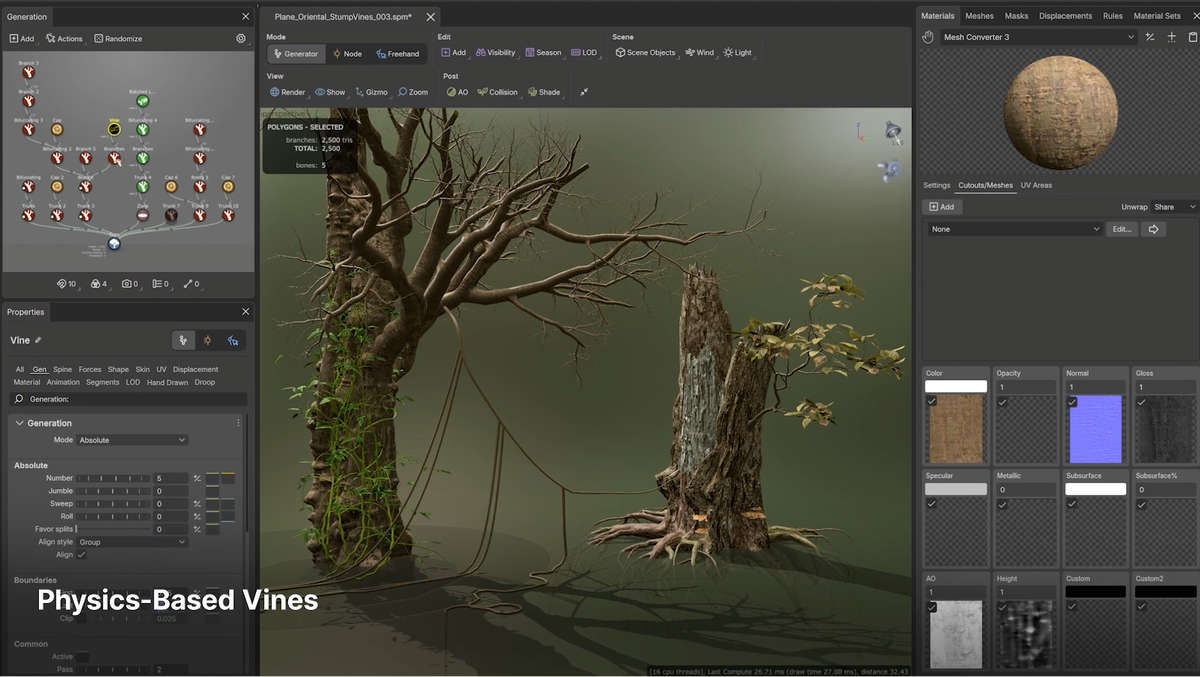
This process isn’t simply dragging assets into a scene. It requires thinking like an environment artist who is also a performance engineer—a tricky balance. We need the visual fidelity to sell the atmosphere, but we absolutely cannot afford framerate drops when hundreds of wind-swept canopy leaves start dancing simultaneously. SpeedTree’s strength lies in its procedural approach, which means we are working with rules and systems rather than just static polygons. It allows us to simulate growth patterns and natural variation that mimic how nature actually behaves, saving us countless hours of manual placement and cleanup.
For those building open-world experiences or simulating detailed environments for cinematics, the level of realism SpeedTree can achieve is staggering. We’re talking about the difference between a sheet set from an asset store and a vibrant ecosystem where every tree tells its own story through its unique structure and behavior. If your project depends on immersion—if you want players to feel they’ve stumbled into a genuine biome, not just a green backdrop—then understanding this workflow with 7.1.4 is essential reading.
Getting realistic foliage into Unity with SpeedTree setup
Setting up the initial assets requires more than just importing files; it demands an appreciation for how light interacts with natural materials. When you first start working within SpeedTree and integrating those assets into your Unity project, focus immediately on material fidelity. The shader network is where magic happens; simply using basic flat colors will make every tree look like a plastic cutout. You need to build up complexity in the shaders to handle subsurface scattering and detailed anisotropic reflection—this captures that crucial sense of organic depth that makes foliage feel genuinely alive when sunlight grazes through it.
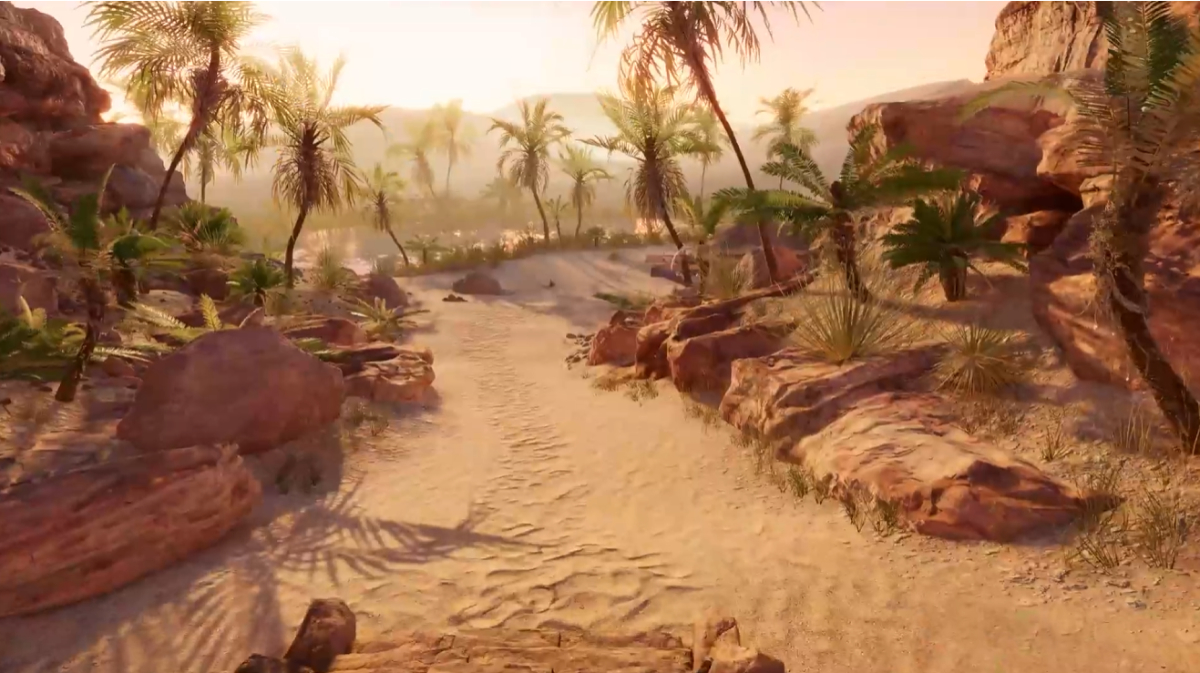
The beauty of the SpeedTree workflow is its modularity, allowing us to define the entire lifecycle of a plant, from the root structure (the invisible foundation) all the way up to the highest canopy leaf. When placing trees, resist the urge to place them in perfect rows; natural placement involves slight overlaps, varied heights, and subtle shifts in orientation. By leveraging SpeedTree’s procedural scattering tools, you can quickly populate an area with a convincing sense of density while maintaining that critical human touch of imperfection—the way some branches lean into the wind or one trunk is slightly crooked.
Beyond mere visual setup, mastering the integration means understanding Unity’s physics and rendering pipeline alongside the tree data. You must configure how leaves react to wind forces within the engine’s particle systems and vertex shaders. A static tree, even if geometrically perfect, feels dead. By setting up dynamic behavior that responds realistically to simulated gusts—a gentle sway here, a sudden whip there—you transform the asset from a mere mesh into an active element of the game world that contributes significantly to the mood and atmosphere.
Mastering optimization for massive, natural forest scenes
When you are dealing with vast biomes—say, a thousand acres of temperate rainforest—the sheer computational cost of rendering every single leaf becomes a nightmare scenario for the framerate. This is where the art of performance engineering kicks in. Merely having beautiful trees isn’t enough; they must be efficient. SpeedTree 7.1.4 provides tools that let us think about optimization at the level of the entire forest, not just individual assets.
The most critical technique to master when building massive scenes is implementing robust Level of Detail (LOD) groups across all your foliage. You cannot render every leaf polygon at maximum detail from a distance; it’s simply wasteful and crippling. The goal is smart scaling: close up, the trees are highly detailed with complex geometry and shaders; far away, they gracefully drop to simplified meshes that maintain visual silhouette but dramatically reduce vertex count and draw calls. This invisible trick is what allows your forest to look massive while keeping the frame rate humming smoothly.
Furthermore, we must utilize advanced culling techniques, particularly occlusion culling. If a section of the forest is behind a ridge or inside a dense patch of rocks, there’s zero need for the GPU to calculate light bounces or draw calls for those trees. By properly mapping out visibility zones and teaching Unity what objects are perpetually hidden from view, you instruct the engine to simply ignore them entirely. This optimization strategy is akin to making sure your rendering budget only pays attention to what the player can actually see, resulting in exponentially smoother performance across enormous play spaces.
Building a truly believable natural environment with SpeedTree 7.1.4 feels less like assembling assets and more like coaxing life into existence within the digital world. It is deeply satisfying because the final result transcends simple graphics; it creates immersion. When everything clicks—when the wind catches that canopy just right, when the light streaks through a perfectly rendered cluster of leaves—you realize you haven’t just built a model; you’ve created an atmosphere.
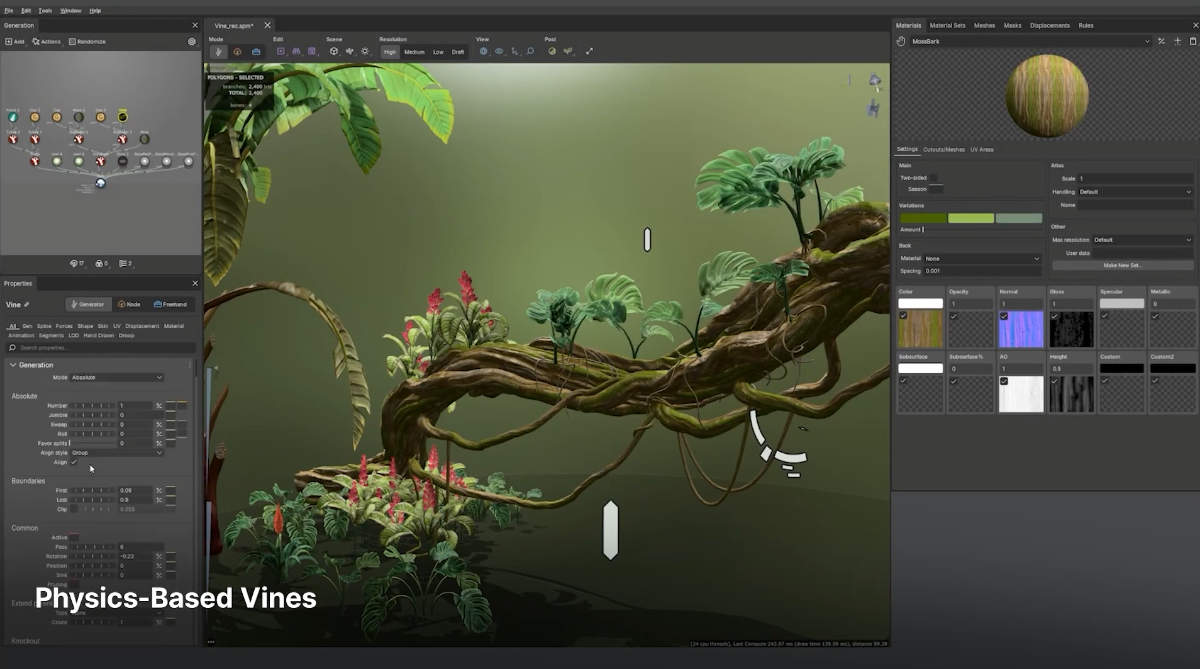
The complexity demands patience and a keen eye for technical detail, forcing us to become masters of both art and performance mathematics. But the payoff is immense: lush, breathtaking worlds that feel genuinely lived-in. For any developer aiming to create environments where the natural world is a primary character, this workflow represents not just an asset choice, but a foundational pillar of believable game design.
? Quick Summary: Building Realistic Foliage
- Focus on Materials: Don’t rely only on geometry; use complex shaders (like subsurface scattering) to give leaves organic depth and life.
- Procedural Placement: Use SpeedTree’s tools for natural, imperfect placement rather than rigid grid layouts.
- Dynamic Behavior: Configure the foliage to react realistically to wind and environment physics for maximum immersion.
- LOD is King: For massive scenes, implement multiple Levels of Detail (LOD) to drastically cut polygon count at distance.
- Optimize with Culling: Use occlusion culling to ensure that hidden parts of the forest are never rendered, saving significant GPU power.
? Frequently Asked Questions about SpeedTree in Unity
How does SpeedTree handle different species variation?
SpeedTree is designed for massive variety. You can build entire libraries of trees and plants that mimic real-world biomes—from delicate weeping willows to sturdy pine groves—all while maintaining a cohesive, natural look within your single project.
Is high foliage density going to kill my game’s framerate?
It can, but it doesn’t have to. By rigorously implementing LOD (Level of Detail) and advanced culling techniques like occlusion culling, you can keep even massive, densely packed forests running smoothly without performance hiccups.
What is the biggest technical challenge when integrating SpeedTree into Unity?
The hardest part isn’t the mesh itself; it’s setting up the materials and shaders correctly. You need to make sure your shaders handle light interaction (like subsurface scattering) so the leaves look translucent and alive, not like solid plastic sheets.
Can I use SpeedTree for everything, or is it limited to trees?
While its core strength is large-scale tree generation, the procedural nature of the software allows you to work with various plant types, including complex undergrowth and bushes, making it a comprehensive environmental toolset.
Do I need to be an expert in shaders to use SpeedTree effectively?
You don’t need to write code from scratch, but having a solid understanding of Unity’s rendering pipeline—specifically how materials, UV coordinates, and lighting interact—will allow you to fine-tune the assets for maximum realism.
⬇️ How to download
It's easy, but here's how it actually works:
- Pick your version from the list.
- Hit the Download button – you'll be taken to a file host.
- ⚠️ Important: disable your AdBlocker – otherwise the site might not work properly.
- If you're on a free or temporary plan, you'll see a 30‑second timer – just wait it out.
- After the timer ends, the real download button appears. Click it and get your file.
✅ No extra installers, no hidden registrations – just a short wait.
🙏 And hey – if you appreciate what we're doing, consider supporting us. This site runs on ads, nothing malicious, just honest help for the community. Every click helps keep the project alive.
💬 Community & Support
We sincerely appreciate everyone who supports our website and shows interest in our work.
Your comments and interaction on the site really help our project grow and reach more 3D artists around the world 🌍.
We also have a Telegram channel — where we share updates, exclusive content, and materials that are not available on the website.
If you're looking for something specific — especially assets for Unity Engine or large 3D model packs that haven't yet been published due to their size — you can leave your request there, and if the files are available, we'll provide a direct download link.
Thank you for being part of our community and helping us keep this creative space alive ❤️
🚀 Join Our Telegram Channel
Get early access to new 3D models, exclusive Unity assets, and behind-the-scenes content.
🔗 Join Telegram💡 Your activity helps us grow — every visit, comment, and share makes a real difference.
We're truly grateful for your support and curiosity 🙏